JEE Main 2026 — Hydrocarbons Question with Solution
JEE Main 2026 (05 April Shift 1)
Question
For the following Friedel Craft's alkylation reaction, which of the statements are correct?
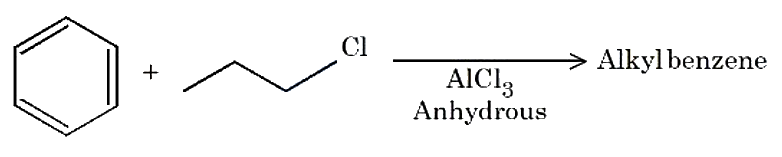
A. Major product is n-propyl benzene.
B. iso-propyl carbocation intermediate is also generated.
C. Multiple substitution is inevitable.
D. Introducing electron-donating substituent on benzene will not produce any alkyl benzene.
Choose the correct answer from the options given below:
A. Major product is n-propyl benzene.
B. iso-propyl carbocation intermediate is also generated.
C. Multiple substitution is inevitable.
D. Introducing electron-donating substituent on benzene will not produce any alkyl benzene.
Choose the correct answer from the options given below:
Choose an option
Show full solutionCorrect option: B
Correct answer
BB and C only
Step-by-step explanation
In the given Friedel-Crafts alkylation reaction, -chloropropane reacts with anhydrous to initially form a primary carbocation, the -propyl carbocation ().
This primary carbocation is less stable and undergoes a -hydride shift to form a more stable secondary carbocation, the iso-propyl carbocation (). Therefore, statement B is correct.
The iso-propyl carbocation then acts as an electrophile and attacks the benzene ring, yielding iso-propylbenzene (cumene) as the major product. Thus, statement A is incorrect.
Once an alkyl group is introduced to the benzene ring, it acts as an electron-donating group (via hyperconjugation and inductive effect), which activates the ring. This makes the newly formed alkylbenzene more reactive towards electrophilic aromatic substitution than the original benzene molecule, leading to polyalkylation. Hence, multiple substitution is a common and inevitable drawback. Therefore, statement C is correct.
Introducing an electron-donating substituent on benzene generally activates the ring and facilitates Friedel-Crafts alkylation (except for strong Lewis bases like which complex with ). Thus, statement D is incorrect.
Therefore, only statements B and C are correct.
Answer: B and C only
This primary carbocation is less stable and undergoes a -hydride shift to form a more stable secondary carbocation, the iso-propyl carbocation (). Therefore, statement B is correct.
The iso-propyl carbocation then acts as an electrophile and attacks the benzene ring, yielding iso-propylbenzene (cumene) as the major product. Thus, statement A is incorrect.
Once an alkyl group is introduced to the benzene ring, it acts as an electron-donating group (via hyperconjugation and inductive effect), which activates the ring. This makes the newly formed alkylbenzene more reactive towards electrophilic aromatic substitution than the original benzene molecule, leading to polyalkylation. Hence, multiple substitution is a common and inevitable drawback. Therefore, statement C is correct.
Introducing an electron-donating substituent on benzene generally activates the ring and facilitates Friedel-Crafts alkylation (except for strong Lewis bases like which complex with ). Thus, statement D is incorrect.
Therefore, only statements B and C are correct.
Answer: B and C only
Practice this on the real CBT interface
Solve this JEE Main question (and the rest of the Hydrocarbons chapter) on PrepSharp's TCS iON-style CBT player — with timer, bookmarks and session analytics.
Solve interactively →About this question
This is a previous-year question from JEE Main 2026, covering the Hydrocarbons chapter of Chemistry. PrepSharp catalogues every PYQ from JEE Main with a verified answer key and step-by-step solution prepared by IIT alumni — so you can search by chapter, topic or year and revise efficiently.