JEE Main 2026 — Electrochemistry Question with Solution
JEE Main 2026 (23 January Shift 2)
Question
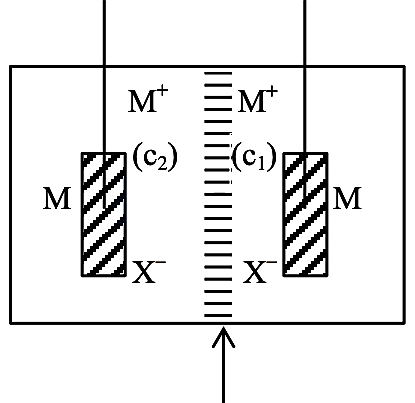
Consider the above electrochemical cell where a metal electrode (M) is undergoing redox reaction by forming . The cation is present in two different concentrations and as shown above. Which of the following statement is correct for generating a positive cell potential?
Choose an option
Show full solutionCorrect option: C
Correct answer
CIf is present at cathode, then .
Step-by-step explanation
The given setup is a concentration cell with identical electrodes (M) and different electrolyte concentrations ( and ).
For a concentration cell, the standard cell potential .
The cell reactions are:
Anode:
Cathode:
Net reaction:
Using the Nernst equation at :
For a positive cell potential (), the term must be negative.
This requires , which means .
If is present at the cathode and is at the anode, then for , we must have .
Checking the options:
(1) If is at cathode, (Incorrect)
(2) If is at anode, (Incorrect, would require )
(3) If is at cathode, (Correct)
(4) If is at anode, (Incorrect, would be zero)
For a concentration cell, the standard cell potential .
The cell reactions are:
Anode:
Cathode:
Net reaction:
Using the Nernst equation at :
For a positive cell potential (), the term must be negative.
This requires , which means .
If is present at the cathode and is at the anode, then for , we must have .
Checking the options:
(1) If is at cathode, (Incorrect)
(2) If is at anode, (Incorrect, would require )
(3) If is at cathode, (Correct)
(4) If is at anode, (Incorrect, would be zero)
Practice this on the real CBT interface
Solve this JEE Main question (and the rest of the Electrochemistry chapter) on PrepSharp's TCS iON-style CBT player — with timer, bookmarks and session analytics.
Solve interactively →About this question
This is a previous-year question from JEE Main 2026, covering the Electrochemistry chapter of Chemistry. PrepSharp catalogues every PYQ from JEE Main with a verified answer key and step-by-step solution prepared by IIT alumni — so you can search by chapter, topic or year and revise efficiently.