JEE Main 2026 — Alcohols Phenols and Ethers Question with Solution
JEE Main 2026 (06 April Shift 1)
Question
Consider the following sequence of reactions
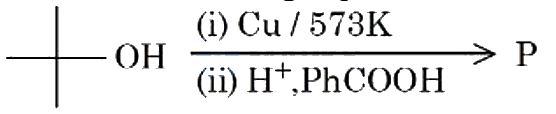
The major product P is:
The major product P is:
Choose an option
Show full solutionCorrect option: C
Correct answer
C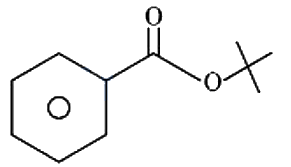
Step-by-step explanation
Step 1: The first reagent is Cu at . When a tertiary alcohol like tert-butyl alcohol is passed over heated copper at , it undergoes dehydration rather than dehydrogenation to form an alkene.
The intermediate product is isobutylene (2-methylpropene).
Step 2: The second set of reagents is and (benzoic acid). This is an acid-catalyzed addition of a carboxylic acid to an alkene, which is a standard method for synthesizing tert-butyl esters.
First, the alkene is protonated by the acid to form the most stable carbocation, which is the tertiary butyl carbocation:
Next, the carboxylic acid acts as a nucleophile and attacks the carbocation. The oxygen atom of the benzoic acid attacks the tert-butyl carbocation, followed by deprotonation:
The final major product is tert-butyl benzoate. Electrophilic aromatic substitution (Friedel-Crafts alkylation) on the benzene ring does not occur here because the group is strongly deactivating, making O-alkylation (ester formation) the highly preferred pathway.
Comparing this with the given options, Option (C) represents the structure of tert-butyl benzoate.
Answer:
The intermediate product is isobutylene (2-methylpropene).
Step 2: The second set of reagents is and (benzoic acid). This is an acid-catalyzed addition of a carboxylic acid to an alkene, which is a standard method for synthesizing tert-butyl esters.
First, the alkene is protonated by the acid to form the most stable carbocation, which is the tertiary butyl carbocation:
Next, the carboxylic acid acts as a nucleophile and attacks the carbocation. The oxygen atom of the benzoic acid attacks the tert-butyl carbocation, followed by deprotonation:
The final major product is tert-butyl benzoate. Electrophilic aromatic substitution (Friedel-Crafts alkylation) on the benzene ring does not occur here because the group is strongly deactivating, making O-alkylation (ester formation) the highly preferred pathway.
Comparing this with the given options, Option (C) represents the structure of tert-butyl benzoate.
Answer:
Practice this on the real CBT interface
Solve this JEE Main question (and the rest of the Alcohols Phenols and Ethers chapter) on PrepSharp's TCS iON-style CBT player — with timer, bookmarks and session analytics.
Solve interactively →About this question
This is a previous-year question from JEE Main 2026, covering the Alcohols Phenols and Ethers chapter of Chemistry. PrepSharp catalogues every PYQ from JEE Main with a verified answer key and step-by-step solution prepared by IIT alumni — so you can search by chapter, topic or year and revise efficiently.